

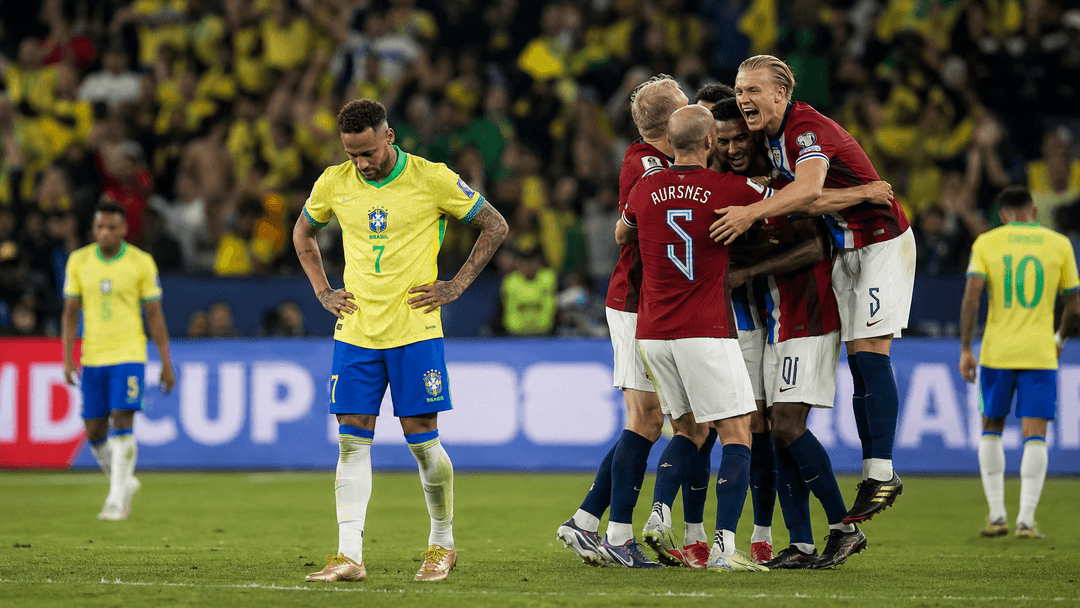
Brazil’s 2–1 loss to Norway ended their 2026 World Cup campaign and raised familiar questions about the gap between Brazil’s historic tournament identity and its modern knockout performances.
Brazil entered the 2026 World Cup with the usual weight of expectation. It does not matter how many new players arrive, who is coaching the team, or how much football has changed around them: when Brazil reach a World Cup knockout match, the expectation is still that they should find a way through.
That is why the 2–1 defeat to Norway in the Round of 16 feels bigger than a normal elimination. Norway deserved the result and will now face the winner of Mexico versus England in the quarter-finals, but Brazil’s exit will inevitably be viewed through the country’s history. This is a team that has won the World Cup five times, reached six official finals since 1958, and spent decades being treated as the tournament’s most natural contender.
Against Norway, however, Brazil could not find the response that once defined their best World Cup sides.
People often speak about Brazil as if every great Brazilian team played exactly the same way: creative, attacking, free, and full of individual brilliance. The reality is more complicated.
The Brazil of 1970 is still remembered as one of the most beautiful international teams ever assembled. Pelé, Jairzinho, Gérson, Rivellino and Carlos Alberto played with movement and confidence that made football feel simple. Their 4–1 final win over Italy was not only a trophy moment; it became part of the image people still have when they think about Brazilian football.
But Brazil also won in very different ways.
The 1994 team was more controlled and pragmatic. It did not overwhelm opponents with the same style as 1970, but it was disciplined, hard to break down, and capable of surviving a tense final against Italy that ended in penalties. In 2002, Brazil had another version of balance: Ronaldinho’s creativity, Rivaldo’s intelligence between the lines, Ronaldo’s finishing, and a system that gave the attack enough freedom without leaving the team exposed.
Those teams did not look identical. What they shared was the ability to handle knockout pressure.
Brazil have had difficult World Cup matches before. They have been behind, frustrated, pressed, and forced into long periods without clear chances. But their strongest tournament teams usually had a way of making the biggest moment feel smaller.
That did not always mean playing beautifully for 90 minutes. Sometimes it meant slowing the match down. Sometimes it meant relying on one player to create a solution. Sometimes it meant defending well enough to wait for the next opportunity.
Against Norway, Brazil could not quite find that control.
The team had already shown signs of resilience earlier in the tournament. Brazil drew with Morocco, beat Haiti and Scotland comfortably, then came from behind to beat Japan in the previous knockout round. That victory suggested Carlo Ancelotti’s side had the patience to manage difficult situations without panicking.
The Norway match changed that feeling. Brazil were no longer the team waiting for the next opening. They became the team trying to force one.
Norway’s strength in this tournament has been clear. They are direct when they need to be, physically strong, organised without the ball, and dangerous when the match opens up. With Erling Haaland leading the attack, they also have a player who changes how every defence positions itself.
Brazil knew what was coming. Norway had already beaten Iraq and Senegal in the group stage, lost heavily to France, and then edged past Côte d’Ivoire in the previous round. They were not an easy opponent, but Brazil still entered the match as favourites because of the talent available across the pitch and the expectation that a team managed by Ancelotti would find the right answer in a knockout tie.
Instead, Norway managed the game better when it mattered.
Brazil had periods where they looked capable of taking control, but knockout football does not reward potential. It rewards the team that uses its key moments more clearly. Norway took enough of theirs to build a 2–1 win. Brazil leave the tournament knowing that the difference was not only about talent, possession, or reputation. It was about whether the team could make the right decisions when the match became tense.
The immediate reaction will focus on the result, the selection, and Ancelotti’s tactical decisions. Those are normal questions after a World Cup exit. But the deeper issue is whether Brazil have built an identity that still works in modern knockout football.
Brazil cannot rely only on technical quality. Almost every major team now has players comfortable on the ball, fast transitions, detailed tactical preparation, and aggressive pressing structures. The old idea that Brazil will simply have more talent than everyone else is not enough anymore.
The next version of the team needs to be clearer in a few areas:
Brazil’s greatest World Cup teams were never only about individual skill. They were also teams with a clear understanding of where the next pass, run, or decision had to come from.
Brazil’s last World Cup final came in 2002, when Ronaldo scored twice against Germany in Yokohama. Since then, the team has remained one of the favourites at almost every tournament, but it has not returned to the final.
There have been different kinds of disappointment along the way. The 2006 quarter-final exit to France. The 7–1 loss to Germany in 2014. The quarter-final defeats in 2018 and 2022. Now, in 2026, an earlier exit against Norway.
Each tournament has had its own story, so it would be too simple to treat them as one repeated failure. But together they show how much harder it has become for Brazil to turn talent into a complete tournament run.
The pressure will now grow around the next cycle. Brazil will still have quality players, still have huge expectations, and still be one of the first teams people mention before any World Cup begins. The difference is that history alone will no longer protect them from difficult questions.
Norway’s victory is also a reminder that the World Cup is no longer built around a small group of untouchable teams. The expanded format has brought more variety into the tournament, but the knockout stage still rewards teams that know exactly what they are.
Norway did not need to outplay Brazil for every minute. They needed to stay close enough, defend well enough, and trust the moments where they could hurt Brazil. That is often how knockout football works. The better-known team carries the pressure. The underdog carries the freedom to wait.
For Brazil, the lesson is not that they need to become Norway. It is that they need to become more decisive about who they are when the match stops being comfortable.
Brain1 fits into that broader football idea through the mental side of the game: attention, reaction, quick recognition, and making controlled decisions when the game changes direction. It cannot recreate the pressure of a World Cup elimination match, but it can support the habits that matter before the final pass, shot, or defensive mistake, link to the app: platform.brain1.com
Brazil’s World Cup is over. Norway move on. And for one of football’s most historic teams, the next challenge is no longer about recreating the past. It is about building a version of Brazil that can survive the present.