

A simple 7-day brain check you can do at home to understand how sleep, stress, phone use, and daily habits affect memory, focus, and reaction speed.
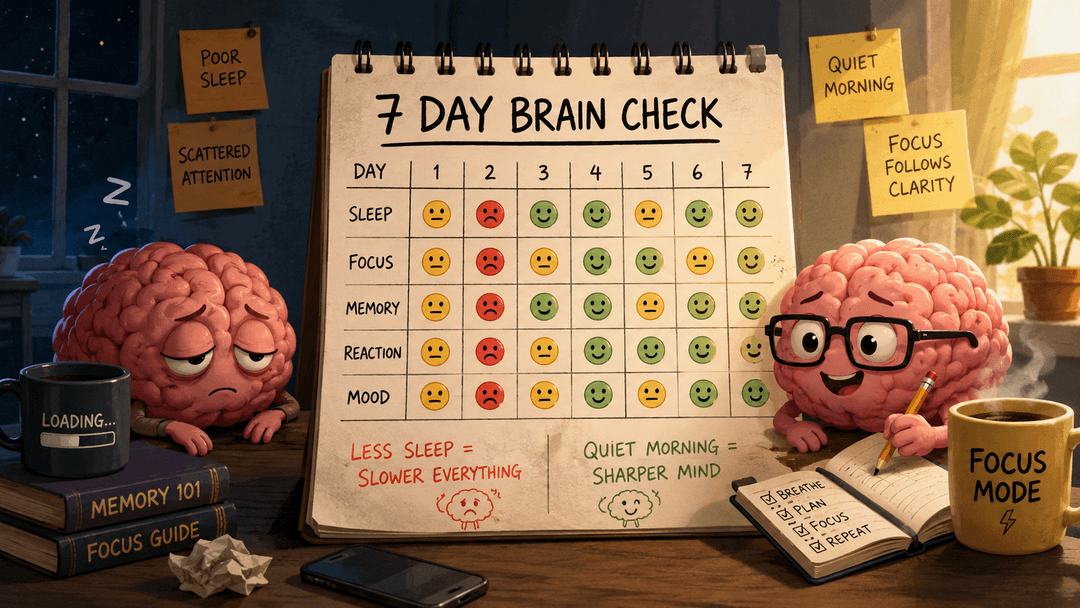
You don’t need a lab, expensive equipment, or a medical test to notice how your brain is working from day to day.
A simple check at home can show you something more useful: patterns.
Maybe your reaction feels slower after poor sleep. Maybe your attention drops after checking your phone first thing in the morning. Maybe stress makes you feel faster, but also more careless. Maybe a quiet morning changes more than coffee does.
The goal is not to diagnose yourself. It’s to notice how your memory, attention, reaction speed, and ability to follow instructions change across a normal week.
Here is what a simple seven-day brain check can look like.
The first day is useful because it gives you a baseline.
You may wake up feeling fine, sit down, and assume your brain is ready to work. Then you try a short reaction task, a simple memory exercise, or a task with a few instructions, and notice something small: you reread the instruction, hesitate before responding, or make a mistake you normally wouldn’t make.
That doesn’t mean anything is wrong. It just shows that feeling “normal” is not always the same as being mentally ready for focused work.
A lot of people only notice their attention when it disappears. But it is more useful to notice the smaller shifts too: how quickly you begin, how often you reread something, whether you lose the thread of a task, and whether you make small careless errors.
The first day is not about judging your score. It is about noticing where you are starting from.
The second day may reveal one of the clearest patterns: sleep changes how your brain feels before you even start working.
After a poor night, reaction can feel slower. You may miss part of an instruction, take longer to make a simple decision, or lose your place halfway through a task. You may still be able to do the task, but it costs more effort.
That is the difference many people miss. Sleep loss does not always stop you from functioning. It often makes normal work feel more expensive.
You can still answer messages, join meetings, make breakfast, and open your laptop. But the margin for error gets smaller. A task that usually takes ten minutes might take twenty. A simple choice starts to feel annoying. You may become more likely to switch between tasks because staying with one thing feels harder.
On a low-sleep day, it helps to move difficult work to your best available window, write more things down, and avoid treating your slower brain as a character flaw.
The third day is about the phone.
Before doing anything else, you check messages, scroll a little, look at updates, maybe answer one thing. Nothing feels dramatic. But now your attention is already split between several unfinished thoughts.
A message you need to reply to later. A notification you ignored. Something you saw in the feed. A small problem you are now thinking about.
Then you try a short cognitive check and feel less focused than usual.
The phone does not always make you “less intelligent.” It often makes you more reactive. Your brain is already waiting for the next piece of input, so staying with one small task becomes harder.
Try doing the same short check before messages on one day and after messages on another. The difference can be surprisingly obvious.
One useful thing about checking yourself over several days is that the problem may not be what you first assumed.
You may think, “My memory is getting worse,” because you forget what you were about to do. But sometimes the memory is fine. The information simply never had your full attention in the first place.
On this kind of day, you may remember a list, a name, or a short set of instructions without much trouble. But you may struggle to stay with one task. You open one tab, then another. You start writing something, then check a message. You read the same line twice because your mind has already moved somewhere else.
That is not always a memory issue. It can be an attention issue.
A practical fix is simple: close extra tabs, write down instructions, keep your phone away, and work in shorter blocks. You may not need to “improve your memory.” You may just need to make it easier for your brain to register what is happening.
The fifth day is where small habits start to matter.
Maybe you slept a little better. Maybe you did not check your phone first. Maybe you drank water before coffee, sat quietly for a few minutes, or started with one clear task instead of a dozen inputs.
The check feels different.
You react faster. You make fewer mistakes. You understand instructions without rereading them. Starting work feels less heavy.
This is not proof that one calm morning solves everything. But it can show you that your brain responds to conditions.
A good day is useful data. Do not only track what makes performance worse. Notice what makes it easier too.
Maybe your best mornings have one thing in common: less phone time, better sleep, quieter space, a simple breakfast, or a clearer first task.
Those patterns are often more practical than chasing one perfect routine.
Stress does not always make you slow.
Sometimes it makes you rush.
You may react quickly, choose quickly, and move quickly through a task. But when you look at the result, there are more small mistakes. You missed a word in the instruction. You clicked too early. You answered before reading the full question. You remembered part of the task but not the order.
That is one of the reasons stress can feel misleading. You may feel active and sharp because you are moving fast. But speed without control can create a mess.
This is where a pause matters.
Read the instruction once. Take one second before responding. Check the final answer. Slow down just enough to stop the brain from turning urgency into careless action.
The goal is not to remove all pressure. Pressure is part of sport, work, exams, meetings, and everyday decisions. The goal is to notice whether pressure helps you focus or makes you rush.
By the seventh day, the point is not to find your “best score.”
The point is to notice the pattern.
Maybe poor sleep made you slower. Maybe phone use made you scattered. Maybe stress made you quick but less accurate. Maybe calm mornings helped. Maybe your memory stayed stable while attention changed a lot.
That information is more useful than one random result from one random day.
You start seeing that brain performance is not fixed. It moves with sleep, stress, environment, phone habits, food, hydration, workload, and recovery.
You may not be “bad at focusing.” You may be trying to focus after a poor night, five notifications, three open tasks, and no real break.
That is a different problem. And it has more practical solutions.
Keep it simple.
Do the check at roughly the same time each day, ideally before messages or social media. Use a short task that includes reaction, simple memory, attention, or following instructions. Then write down a few basic notes:
You do not need a complicated spreadsheet. A note on your phone or a page in a notebook is enough.
The important part is consistency. You are not trying to prove that one day was good or bad. You are trying to compare similar checks under different conditions.
Brain1 can work as a short daily cognitive check-in during this kind of experiment.
You can use a few quick tasks to challenge reaction, attention, memory, inhibition, and decision-making, then compare how you feel after a good night of sleep, a stressful day, or a morning spent scrolling.
It is not a medical test, and it cannot diagnose anything. But it can give you a more structured way to notice your own patterns.
Try it at the same time for a week. Keep a few notes next to it. The score matters less than the trend, platform.brain1.com
Testing your brain function at home does not need to be serious or complicated.
A short daily check can show you what affects you most: sleep, stress, notifications, phone use, calm mornings, distractions, or rushed work.
The value is not in one perfect result.
It is in seeing the pattern.
Once you know what makes your brain feel slower, sharper, calmer, or more scattered, you can start changing the conditions around your work instead of blaming yourself for every off day.