

Obvious mistakes are easy to miss when the brain relies on expectations, familiarity, and incomplete attention. Here is why it happens and how to catch more errors.
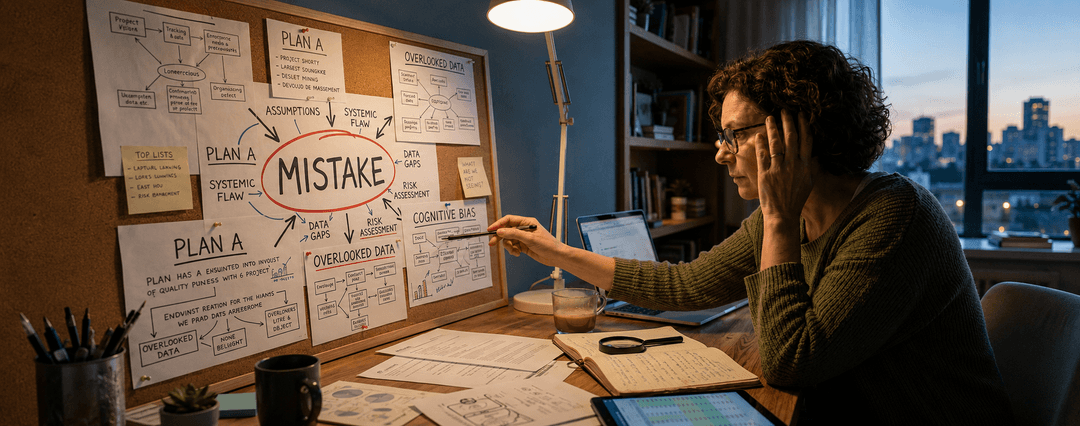
You read the same sentence three times and still miss the missing word.
You look at a design for an hour without noticing that one element is misaligned. You send a message and only later see the typo in the first line. You follow a familiar process, complete every step, and then realise that one important detail was wrong from the beginning.
The mistake can seem painfully obvious afterward. That often leads to a frustrating question: how did I not see it?
The answer is usually not carelessness. The brain does not inspect every detail with equal depth. It uses expectations, patterns, and previous experience to process information quickly. Most of the time, this is useful. It allows you to read smoothly, recognise familiar objects, and complete routine tasks without analysing every small part.
But the same shortcuts can hide errors that are directly in front of you.
When you look at familiar information, your brain does not process it as if it were completely new. It predicts what should come next and uses that prediction to fill in missing or unclear details.
This is one reason people can read a sentence with a repeated word or a small spelling error without noticing it. The overall meaning is clear, so the brain moves forward instead of stopping to inspect every letter.
The same thing happens outside reading. If a button is normally in the top-right corner, you may assume it is there without carefully checking. If a report usually follows the same structure, you may skim familiar sections and focus only on what seems new.
Expectation makes processing faster, but it can also replace observation.
You may believe you are checking what is actually there when you are partly checking what you expected to be there.
The longer you work with something, the harder it can become to see it clearly.
A designer who has reviewed the same screen many times may stop noticing uneven spacing. A writer may read the intended sentence instead of the sentence that was actually written. Someone completing a routine procedure may move through the steps automatically and miss a small change.
Familiarity creates efficiency. You no longer need to think carefully about every part of the task. But it also makes certain details less visible because the brain begins treating them as known information.
This is why another person may immediately spot an error you have missed for hours. They are not necessarily more observant. They simply do not have the same expectations.
They see the current version. You see the current version mixed with the version already stored in your mind.
People often imagine attention as a spotlight that reveals everything in front of them. In reality, the spotlight is narrow.
When you focus on one part of a task, other details receive less processing. You may be checking whether the numbers in a report are correct and fail to notice that the date is wrong. You may focus on the colour balance of a design and miss a spelling mistake. You may listen closely to the meaning of a sentence and overlook the way it was phrased.
This is especially common when several types of accuracy are required at once.
A single document may need to be checked for:
Trying to inspect all of these at the same time sounds efficient, but usually makes the review less reliable. Attention keeps shifting between categories, and some errors remain hidden because they never become the main target.
The brain is very good at understanding patterns as a whole.
You recognise a face without examining every feature. You understand a paragraph without consciously analysing every word. You can identify an object even when part of it is hidden.
This ability is essential, but it means that small errors can disappear inside a clear overall pattern.
A sentence with one incorrect word may still communicate the intended meaning. A chart with a wrong label may still look visually convincing. A familiar interface may feel correct even when one component is in the wrong position.
When the larger structure makes sense, the brain has less reason to investigate individual details. The mistake does not interrupt understanding strongly enough to attract attention.
That is why obvious errors are often easier to notice when they change the meaning, break the visual pattern, or create a surprising result.
It is usually more difficult to review your own work than someone else’s.
When you create something, you know what you intended to say, show, or achieve. That intention remains active while you review the result. Instead of seeing only the final output, you also see the plan behind it.
A writer knows the missing idea that was supposed to connect two paragraphs. A designer knows what a button is meant to do. A person preparing a presentation knows what the unfinished chart represents.
The audience does not have access to that intention. They only see what is actually present.
This gap explains why creators sometimes believe something is clear when other people find it confusing. The missing information exists in the creator’s mind, so it does not feel missing.
Obvious errors become easier to miss when you are tired.
Careful checking requires attention, working memory, and inhibition. You need to slow down, resist the urge to assume everything is correct, and compare what you see with what should be there.
When mentally tired, the brain is more likely to rely on shortcuts. It skims instead of inspecting, accepts familiar patterns, and moves forward once the general meaning is clear.
This can happen after long periods of work, repeated revisions, several meetings, or constant switching between tasks. You may still feel capable of continuing, but the quality of your checking can decline before you notice strong fatigue.
Late-stage reviewing is particularly risky. The closer you are to finishing, the more strongly you want the task to be complete. That desire can make you less willing to reopen problems.
Reading quickly and checking carefully are different activities.
When you move fast, attention focuses on meaning and direction. You want to understand what the text says, whether the design works, or whether the process reaches the expected result.
Detailed review requires a different pace. You must stop treating the material as a whole and inspect smaller parts separately.
Many errors survive because people try to proofread at the same speed they normally read. Their eyes move through the content, but their brain continues processing the general message rather than the exact details.
Slowing down helps, but simply telling yourself to pay more attention is often not enough. The review method also needs to change.
Once someone points out the mistake, it can become impossible not to see it.
This happens because your expectations have changed. Before the error was identified, your brain predicted that the content was probably correct. Afterward, it begins looking for the specific problem.
The mistake did not suddenly become more visible on the page. Your attention received a new target.
This can create the false impression that you should have noticed it immediately. But seeing an error after being told where it is requires less effort than discovering it without guidance.
The brain is much better at confirming a known problem than searching through many possible types of problems at once.
One of the most effective ways to catch more errors is to stop checking everything simultaneously.
Instead, review the same material several times with a different goal on each pass.
For example:
Each pass gives attention one clear target. This reduces the chance that a strong overall impression will hide a smaller problem.
The process may appear slower, but it is often faster than discovering errors after the work has already been shared.
A small visual change can make familiar work feel new again.
Try changing the font, increasing the text size, switching from a screen to paper, or viewing the design at a different scale. Writers sometimes read text aloud because spoken language exposes missing words and awkward phrasing differently from silent reading.
You can also review the material in reverse order. Checking the final paragraph first or reading individual sentences from bottom to top weakens the normal flow of meaning. This makes it harder for the brain to predict what comes next and easier to notice the exact words.
For visual work, mirror the image, use grayscale, or temporarily hide surrounding elements. A changed perspective interrupts familiarity.
Time away from a task helps because it weakens the connection between intention and output.
After a break, you remember less of what you meant to create and rely more on what is actually visible. Even a short pause can improve error detection, especially after a long editing session.
The length of the break depends on the importance of the work. Ten minutes may be enough for a routine message. A major document, campaign, or product screen may benefit from being reviewed the next morning.
When possible, avoid making the final review immediately after the final edit. Editing keeps your attention on individual changes. A separate review needs a wider and more neutral perspective.
People often make the same types of errors repeatedly.
You may forget to check dates, use inconsistent button labels, leave placeholder text, or miss alignment problems near the edge of a layout. A short checklist turns these known weaknesses into explicit review targets.
A useful checklist should be specific. “Check everything” is too broad to guide attention. Better items might include:
The checklist does not replace judgment. It protects you from relying entirely on memory when the task feels familiar.
A fresh reviewer can notice gaps that have become invisible to the creator.
The most useful feedback does not always come from an expert. Sometimes a person unfamiliar with the task can reveal whether the meaning is clear, the sequence feels natural, or an important instruction is missing.
Instead of asking, “Does this look good?” give the reviewer a specific task. Ask them to explain what they think the page is for, find a particular piece of information, or complete the process without guidance.
Their behaviour may reveal problems that neither of you would notice through passive inspection.
Reviewing requires a different mental state from creating.
Creative work often depends on momentum, association, and experimentation. Checking depends more on inhibition, precision, and the ability to question familiar information.
A short pause can help create that shift. Stand up, look away from the screen, take a brief walk, or complete a simple activity before returning to review.
Brain1 can also be used as a short cognitive check-in before detailed work. Its games involve attention, reaction, memory, inhibition, and decision-making. It cannot guarantee that you will find every mistake, but it can help you notice whether your responses feel steady or whether fatigue may be affecting your accuracy, link to the app: platform.brain1.com
The goal is not to become perfectly observant. It is to stop assuming that continued looking automatically means continued seeing.
You miss obvious mistakes because the brain is designed to process information efficiently, not inspect every detail equally.
It relies on expectations, fills in familiar patterns, focuses on selected information, and uses your intention to interpret your own work. Fatigue and speed make these effects stronger.
Catching more errors requires changing the conditions of the review. Separate different types of checking, create visual distance, take a break, use specific checklists, and involve someone who does not already know what the result is supposed to be.
An obvious mistake is not always invisible because you were not looking.
Sometimes you were looking directly at it, but your brain had already decided what it expected to see.
Soft CTA: Try Brain1 as a short attention check before reviewing important work, then compare how many details you notice before and after a brief reset.