

Spain defeated Argentina 1–0 after extra time to win their second World Cup. Ferran Torres scored the decisive goal in a final shaped by patience, substitutions, discipline, and one late moment.
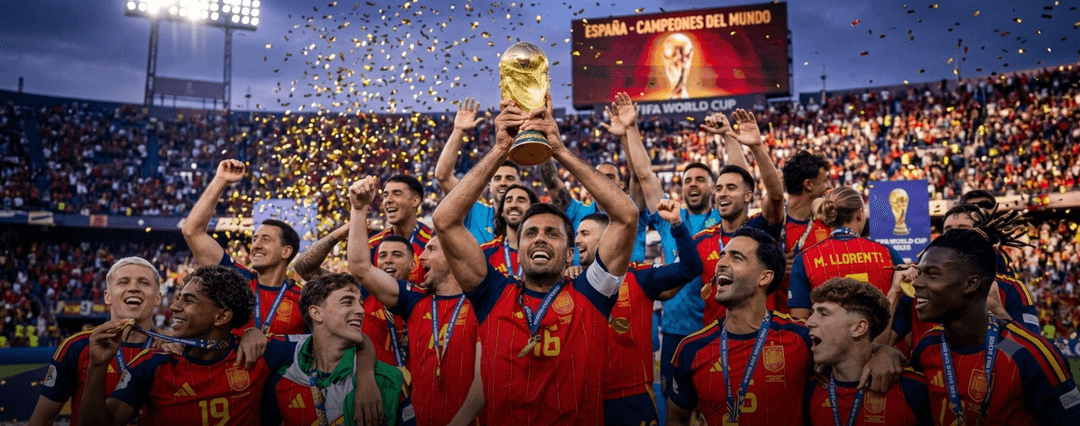
Spain became world champions for the second time, but their victory over Argentina did not arrive through a spectacular attacking performance or an early goal that opened the match.
It came through patience.
For more than 100 minutes, Spain controlled possession, pushed Argentina backwards, and repeatedly searched for a way through a defensive structure that refused to collapse. Argentina offered almost nothing in attack during normal time, but they remained close enough to take the final toward penalties. Then Enzo Fernández was sent off in stoppage time, the balance shifted further, and Ferran Torres finally scored in the 106th minute.
Spain won 1–0 after extra time, adding the 2026 title to the country’s first World Cup triumph in 2010. Ferran Torres became the decisive substitute, while Argentina’s attempt to defend the trophy ended without a shot on target.
The final created a difficult psychological situation for Spain. They had the ball, created the chances, and appeared to be the stronger team, but the scoreboard remained 0–0.
That can be one of the most dangerous moments for a favourite. As time passes, possession starts to feel less valuable. Players become impatient, passes are forced, defenders move too far forward, and the team that has barely attacked begins to believe it can survive until penalties.
Spain avoided most of those mistakes.
They continued to build attacks without completely abandoning their structure. Argentina defended deeply and disrupted the rhythm whenever possible, but Spain did not turn the game into a desperate exchange of transitions. Even when the match lacked the drama expected from a World Cup final, Spain remained committed to the process that had taken them through the tournament.
Their dominance was clear in the numbers. Spain produced 20 attempts, while Argentina did not register a shot on target. Emiliano Martínez repeatedly kept his team in the match before Torres finally broke through.
Argentina entered the final as defending champions and with a team experienced in surviving emotionally difficult matches. Their path through the knockout stage had already included extra time, comebacks, and narrow victories.
Against Spain, however, survival became almost the entire plan.
Argentina spent long periods protecting the space around their penalty area and limiting Spain’s most creative players. Lionel Messi was forced to receive the ball far from the areas where he could decide the game. When Argentina regained possession, they rarely had enough players or space to build a meaningful counterattack.
The approach worked in one sense: the match remained goalless for 90 minutes. But it also meant Argentina had almost no way of changing the game themselves. They were waiting for a Spanish mistake, a set piece, or a penalty shootout rather than creating a path toward the trophy.
By the 75th minute, Argentina had not attempted a single shot, becoming the first team to reach that point without one in a World Cup final. They finished the match without testing Unai Simón.
The decisive tactical change began before the goal.
Enzo Fernández received his first yellow card in the 82nd minute and was dismissed in the third minute of stoppage time after a late challenge on Pau Cubarsí. Argentina entered extra time with ten players and an even greater need to protect their penalty area.
A red card does not automatically produce a goal. Sometimes the team with ten players becomes more compact and even harder to break down. Spain still had to remain patient, move Argentina from side to side, and recognise when the defensive line was beginning to lose its shape.
The greater difference was mental. Argentina could no longer wait for the same opportunities. Every defensive movement required more energy, every lost duel created a larger gap, and every Spanish substitution became harder to manage.
Spain understood that the advantage did not need to be used immediately. They did not have to score with the first attack of extra time. They only had to keep creating situations where Argentina’s tired defence was asked to make one more decision.
The goal in the 106th minute captured one of the strongest qualities of Spain’s tournament: their depth.
Pedro Porro delivered the ball toward the far post. Nico Williams headed it back into the centre, and Ferran Torres finished powerfully beneath the crossbar. The move was quick, direct, and very different from the slow passing sequence people might expect when describing Spanish football.
It was also created by players who had not started the match.
That matters because tournament football is not won only through the first eleven. The later the competition goes, the more important substitutions become. Players carry fatigue from previous rounds, matches move into extra time, and the coach must introduce energy without damaging the team’s structure.
Torres had lost his starting position after Spain’s opening match, but he remained ready for the moment that eventually defined the entire tournament. He entered the final in the second half and scored the World Cup-winning goal.
The finish will be remembered, but the more interesting detail is what happened before it. Porro recognised the opportunity to cross. Williams chose to return the ball into the dangerous central space rather than attempt a difficult finish. Torres positioned himself for the second action and struck without hesitation.
Three fast decisions turned more than 100 minutes of pressure into one goal.
The score naturally invites comparison with Spain’s first World Cup title. In 2010, Andrés Iniesta scored in the 116th minute as Spain defeated the Netherlands 1–0 after extra time.
Sixteen years later, Spain again won a final 1–0 through a late extra-time goal.
But the two teams should not be treated as copies.
The 2010 side was built around exceptional central control. Xavi, Iniesta, Sergio Busquets, Xabi Alonso, and David Silva could keep possession for long periods and slowly remove the opposition’s ability to influence the game.
The 2026 team were more varied. They could dominate possession, but they also attacked through wide players, pressed aggressively, and used quicker direct actions when the opportunity appeared. Lamine Yamal offered unpredictability on the right, Nico Williams brought speed from the bench, and Spain’s full-backs regularly became part of the attacking structure.
The winning goal did not come from passing until Argentina lost concentration. It came from a cross, a header across goal, and an immediate finish.
This was still recognisably Spanish football, but it belonged to a new generation.
Before the final, Spain had already equalled the international record of 37 consecutive matches without defeat. Winning against Argentina extended that run to 38 and gave it the result that transforms a strong sequence into a historic era.
An unbeaten record can sometimes be misleading. Teams may build long runs through friendlies or favourable schedules. Spain’s sequence ended with victories over Portugal, Belgium, France, and Argentina in the knockout stages of a World Cup.
They also combined the world title with the European Championship won in 2024. Luis de la Fuente’s side therefore did not simply produce one successful month. They created a period of sustained international dominance.
Their World Cup campaign was also built on defence. Spain conceded only one goal across eight matches, setting a record for a tournament champion. The attackers provided the decisive moments, but the consistency of the defensive structure gave them the time to find those moments.
For Lionel Messi, the final may have been his last appearance at a World Cup.
After lifting the trophy in 2022, he reached another final four years later, but Argentina could not create the kind of match in which he could become decisive. Spain limited the spaces around him, prevented Argentina from progressing through midfield, and forced him to spend too much time receiving the ball far from goal.
The defeat does not change what Messi achieved with Argentina. He had already completed the central ambition of his international career in Qatar. But the contrast between the two finals was striking.
In 2022, Argentina and France produced one of the most open and dramatic finals in history. In 2026, Argentina spent most of the match defending and waiting. Messi remained on the pitch, but the game rarely reached him in the places where he could shape it.
His likely World Cup farewell ended not because of one missed chance, but because Argentina never created enough of them.
Spain’s title was built on a skill that is easy to overlook: remaining accurate when the expected result is taking too long.
After 60 or 70 minutes of control without a goal, players can begin making emotional decisions. They shoot from poor positions, force passes through closed spaces, or move forward without protecting the next transition. Spain had to resist that urge while continuing to search for a solution.
That required attention, inhibition, scanning, and fast recognition. The winning move depended on players seeing the next action before the defence could reset.
Brain1 can support those abilities through short cognitive games focused on reaction, attention, visual processing, memory, and decision-making. It cannot reproduce a World Cup final or replace tactical training on the pitch, but it can help players practise the mental habits involved in staying alert, recognising options, and responding under time pressure, link to the app: platform.brain1.com
The final itself may not be remembered as the most entertaining match of the tournament. It was cautious, physical, and often slow. Argentina offered little in attack, while Spain needed extra time and a numerical advantage to turn dominance into a goal.
But champions are not required to win every match beautifully.
Spain stayed patient when the scoreboard gave them no reward. Their substitutes changed the game. Their defence remained stable. When the decisive opening finally appeared, three players processed it correctly and Ferran Torres finished it.
Spain’s first World Cup title was associated with one of the greatest midfield generations international football has seen. Their second should be remembered for something slightly different: a team with enough intelligence, depth, and discipline to keep searching without losing control.
They did not win the final through perfection.
They won because, after 105 goalless minutes, they were still thinking clearly enough to recognise the moment that mattered.