

Cristiano Ronaldo scored twice as Portugal beat Uzbekistan 5–0 at the 2026 World Cup, setting new records and giving the team a much-needed response after their opening draw.
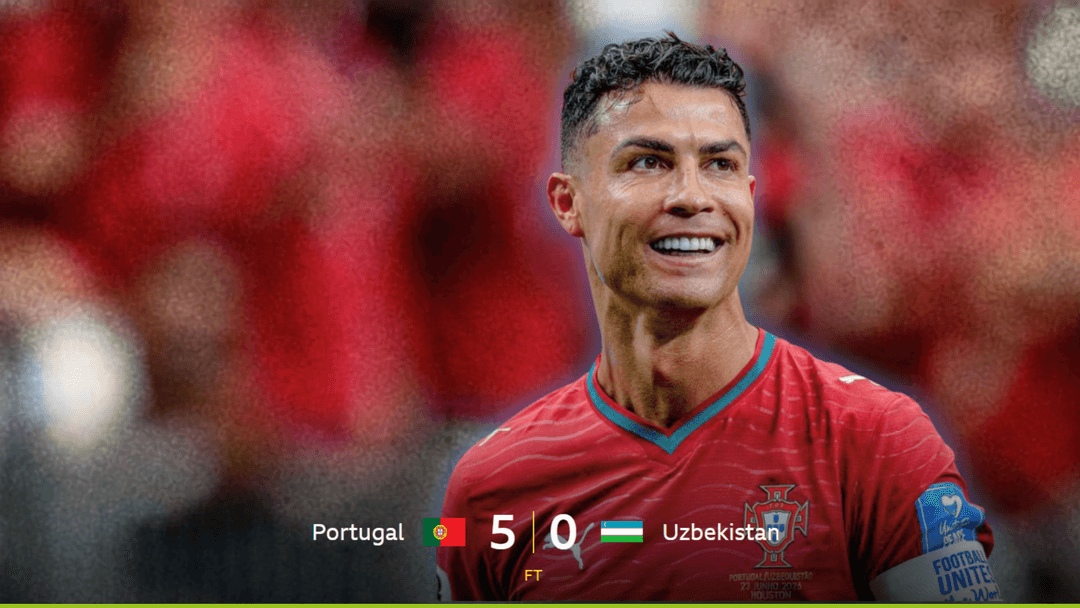
Portugal needed more than three points against Uzbekistan. After the 1–1 draw with DR Congo, they needed a performance that made the opening match look like a warning rather than a pattern.
They got it in Houston.
Portugal beat Uzbekistan 5–0, with Cristiano Ronaldo scoring twice in the first half and setting two major World Cup records in the process. The result moved Portugal to the top of Group K on four points, but the more important change was in the way the team played. Against DR Congo, Portugal had possession without enough conviction near goal. Against Uzbekistan, their attacks had clearer purpose: earlier passes, more runners in the box, and fewer moments where the move slowed down before the final action.
That matters because, in our earlier article, “Cristiano Ronaldo’s Final World Cup: Four Challenges That Could Define Portugal’s Tournament,” the main question was whether Portugal could find the right balance around their captain. Ronaldo still needed to be dangerous, but Portugal could not become a team waiting for him to solve every attack alone. This match was a much better version of that balance.
Portugal scored in the sixth minute. João Cancelo reached the right side of the box and sent a low ball toward the near post. Ronaldo had already made the run. He arrived before the defender could adjust and finished with one touch.
It was a simple goal, but it showed why Ronaldo remains useful in tournament football. He does not need to dominate a match with long dribbles or cover huge distances. He still knows where the next opening will appear, especially inside the penalty area. Against a defence that has not yet settled, that kind of timing is often enough.
The goal also made him the first player in history to score at six World Cups:
Portugal added a second through Nuno Mendes’ free kick, but Ronaldo’s next contribution was even more important for the shape of the match. In the 39th minute, Bruno Fernandes released him during a quick counterattack. Ronaldo received the pass on the right side of the box and finished low into the far corner.
That was his tenth World Cup goal, taking him past Eusébio as Portugal’s top scorer in World Cup history.
The match showed what Portugal were missing in the first game
Against DR Congo, Portugal often had the ball in good areas but lacked the decisive pass or run that turns control into a chance. Uzbekistan gave them more room, but Portugal also used that space better. The team did not wait for the perfect opening. It attacked when the opportunity appeared and made the defence react earlier.
The main differences were clear:
That broader threat matters more than Ronaldo’s double by itself. Uzbekistan had to track his movement inside the box, but that attention opened spaces for the players around him. Nuno Mendes scored, Rafael Leão scored late, and even the own goal came from Portugal keeping pressure on the opposition rather than allowing the game to drift.
Uzbekistan had a brief opening, but Portugal stayed calm
Uzbekistan thought they had pulled one back in the 29th minute when Azizjon Ganiev scored, but VAR ruled the goal out because of a foul on Cancelo earlier in the move.
That was a potentially awkward moment. At 2–1, Portugal might have started to feel the same tension that followed the draw with DR Congo. Instead, Ronaldo’s second goal came ten minutes later and removed the uncertainty before halftime.
The second half was far more comfortable. Uzbekistan goalkeeper Abduvohid Nematov scored an own goal in the 60th minute, and Rafael Leão completed the 5–0 win in the 87th. Portugal were no longer trying to protect a narrow lead or force a response. They were controlling the match with the confidence of a team that had finally found its rhythm.
Ronaldo’s role has been discussed for years because his reputation is so large that every Portugal performance becomes a debate about whether the team should still be built around him. This match did not end that debate, and it should not. Colombia will be a much tougher opponent, with less space and more pressure in midfield.
But the Uzbekistan game did show a useful version of Portugal with Ronaldo in the centre of it. He remained the main finishing threat. He made history. He scored twice. Yet the team did not look like it needed every move to end with him.
That is probably the best possible formula for Portugal. Ronaldo can occupy defenders, attack the key spaces in the box, and finish when the chance appears. Bruno Fernandes, Leão, Cancelo, Nuno Mendes and the midfield can then use the space around him rather than wait for him to rescue the attack.
The next test is whether Portugal can repeat that balance against Colombia, when the decisions will need to be quicker and the chances will be fewer.
Ronaldo’s first goal was decided before he touched the ball. He read Cancelo’s movement early, chose the near-post run, and arrived before the defender reacted. Those are small decisions, but they are the difference between being close to the ball and scoring.
That is also the kind of football detail worth watching during the World Cup. Look at the seconds before the highlight: who scans, who moves first, who recognises space before it becomes obvious.
Brain1 can be used as a short cognitive warm-up for reaction, attention, and quick decision-making before training, a match, or even while watching football more actively. It will not replace work on the pitch, but it is a simple way to practise the mental skills that often show up before the final pass or finish, link to app platform.brain1.com
Portugal now lead Group K with four points, ahead of Colombia on three. DR Congo have one point, while Uzbekistan remain bottom without a point. Portugal face Colombia in their final group match, and that game will reveal much more about whether this result was a genuine shift or simply a comfortable win against a debutant side.
For Ronaldo, though, the message was already clear. After an opening match that raised questions, he answered with two goals, two records, and a performance that gave Portugal’s World Cup campaign real momentum.