

The Ayumu paradigm and its structural relationship to Scan Plan
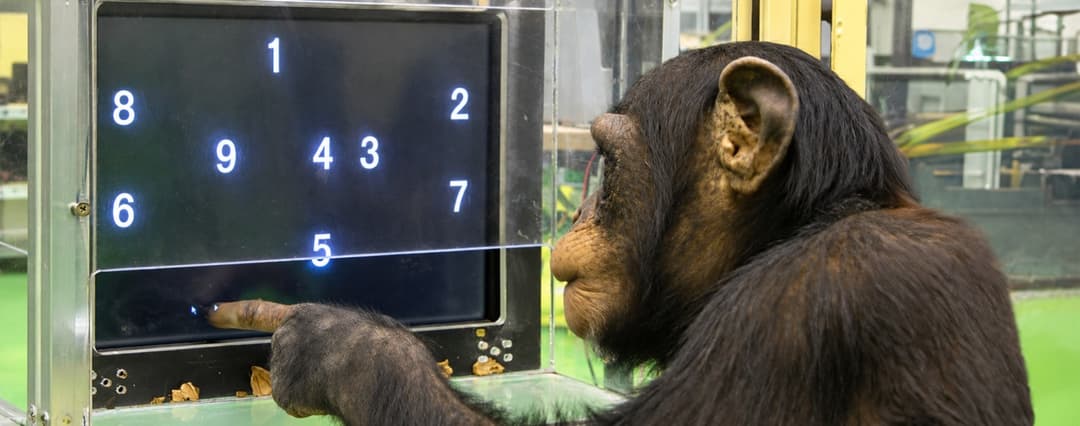
Tasks that require briefly presented information to be retained and used immediately provide a useful way to study working memory. One well-known example is a series of numerical sequencing experiments conducted with chimpanzees at Kyoto University. In these experiments, subjects viewed numerals arranged at random spatial locations and then selected their concealed positions in ascending order.
A related task structure appears in Scan Plan, a Brain One game in which players observe numbered characters, retain the association between each number and its position, and reconstruct the sequence after the numbers are no longer visible. The comparison does not establish a cognitive benefit of the game; it identifies an overlap between the information-processing demands of the two tasks.
In 2007, researchers Sana Inoue and Tetsuro Matsuzawa at Kyoto University reported the results of a touchscreen study involving six chimpanzees - three mothers and their young - and human university students. The chimpanzees had first learned to recognize Arabic numerals and touch them in ascending order.
The researchers then introduced a memory challenge. In one version, several numerals appeared in random positions. After the subject touched the first numeral, the others were replaced by blank squares. To complete the trial, the subject had to remember the hidden locations and continue touching them in numerical order.
A more demanding version limited how long the numerals could be seen before all of them were covered. Five numerals were displayed for 650, 430, or 210 milliseconds. As the presentation time became shorter, the performance of the human participants declined. Ayumu maintained comparatively high accuracy at the shortest exposure and substantially outperformed the untrained human participants under that condition.
An exposure of 210 milliseconds provides little opportunity for serial visual inspection. Successful performance therefore depends on rapid encoding of the display and temporary retention of the associations between numerical identity and spatial location.

This type of numerical sequencing task combines several processes rather than measuring a single, isolated capacity:
Working memory is especially important here. It allows us to keep a small amount of information available long enough to use it. In this task, remembering the numbers alone is not enough: the player must preserve the link between each number and a position, then act on that map in the correct sequence.

Scan Plan applies the same core task structure used in the Kyoto University experiment. Several characters appear in different positions, each displaying a number. After a brief observation period, the characters turn and the numbers are hidden. The player must remember which number belongs to each character and select them in ascending numerical order.
As the number of characters increases, the player must retain more number-location associations simultaneously. This progressively increases the demands placed on visual attention, rapid information encoding, visuospatial working memory, and sequential recall.
In this way, Scan Plan translates the experimental paradigm into an interactive game environment while preserving its central cognitive challenge: briefly observing numerical information, retaining its spatial arrangement, and reconstructing the correct sequence after the visual cues disappear.
Interpretation of the original human-chimpanzee comparison requires attention to training history. Ayumu had extensive prior experience with number-order tasks, whereas the human participants were not given equivalent preparation before the reported comparison.
Subsequent research examined human performance after practice. Studies by Alan Silberberg and David Kearns, and by Peter Cook and Margaret Wilson, reported substantial improvements; under some comparable five-number conditions, practiced human participants matched or exceeded the previously reported chimpanzee performance.
These results indicate that performance is sensitive to task familiarity, learned strategies, and practice. They also caution against treating the original result as evidence of a general difference between chimpanzee and human intelligence. The evidence concerns performance on a narrowly defined visuospatial sequencing task.
The cited studies did not evaluate Brain One or Scan Plan. They therefore cannot be used to claim that playing Scan Plan improves working memory, transfers to everyday cognitive performance, or produces a clinical or educational benefit.
A more limited conclusion is supported: Scan Plan is constructed around information-processing demands that resemble those present in established numerical memory paradigms. These include rapid visual encoding, visuospatial working memory, maintenance of number-location bindings, and ordered recall. Determining whether repeated play changes any of these capacities would require a controlled study with defined outcome measures, comparison conditions, and pre- and post-intervention assessment.
The Ayumu experiments illustrate how a simple numerical display can place simultaneous demands on perception, spatial memory, and sequence control. Scan Plan implements a related structure through numbered characters whose identifying information becomes unavailable before the response is made. The connection is scientifically relevant at the level of task design, while conclusions about training effects or cognitive improvement remain open empirical questions.